

The Submerged 90 Principle
Ninety percent of what determines a data initiative's fate never appears on the roadmap.
Ninety percent of what decides whether a data initiative succeeds is invisible at the point of purchase. It sits below the surface in executive sponsorship, governance discipline, architectural rigor, data quality, and adoption. My doctoral research found that executive sponsorship and governance-as-trust predict the return on a data initiative more reliably than any technology stack decision.
I have watched that same pattern repeat across five overlapping waves of this industry, from the data warehouse to big data to self-service BI to cloud BI and now to autonomous agents. The tooling changed every time. The failure rate did not. Decades of research place it between sixty and eighty percent, unchanged across every wave.
Infrastructure precedes application. Governance precedes autonomy. Every framework below is one application of that single principle to a specific layer of the problem.
From Cloud BI to the Agentic Enterprise.
The Six Critical Success Factors for Cloud BI
Grounded in doctoral research. BI professionals screened and interviewed in depth.
My dissertation asked a direct question: what actually determines whether a cloud business intelligence implementation succeeds? Not in theory, but in the accounts of practitioners who have delivered these systems across industries. Six factors emerged from the interviews, each aligned to Critical Success Factor theory, the lineage that runs from Daniel in 1961, through the strategic extensions of the 1970s and 1980s, to Rockhart's framing of CSFs as an executive tool in 1979.
These are the conditions that separate a cloud BI investment that performs from one that becomes a cost center.
1. Strategic Alignment and Executive Leadership
Leaders articulate, sponsor, and sustain a cloud BI vision tied explicitly to organizational strategy and value. Executive ownership of the metrics, and a willingness to invest over time, rather than treating BI as a one-off IT project.
2. Project Governance, Planning and Resource Management
The structures and routines that prioritize demand, scope the work, manage risk, and allocate scarce resources. Disciplined governance that still recognizes how quickly cloud BI evolves.
3. Technical Architecture, Engineering and Cloud Platform Execution
The technical underpinnings: environment provisioning, data architecture, security, performance, and platform optimization. Building foundations robust enough to sustain today's analytic workloads and tomorrow's AI capabilities.
4. Collaboration, Communication and Stakeholder Partnership
The quality of the relationships among consultants, business stakeholders, IT, and sponsors. Empowered product owners and champions who broker the conversations and align expectations.
5. Data Quality, Governance and Trust
The processes, roles, and tools that make data accurate, consistent, and understood. This reaches past technical validation into stewardship and a shared understanding of what each metric actually means.
6. End-User Engagement, Adoption and Change Management
How end users are engaged, prepared, and supported to actually use what gets built. Usability, training, communication, and structured change management that turn a delivered system into a used one.
The pattern underneath all six: the factors that decide a cloud BI outcome are mostly organizational and human, not technical. The technology is necessary. It is rarely what fails.
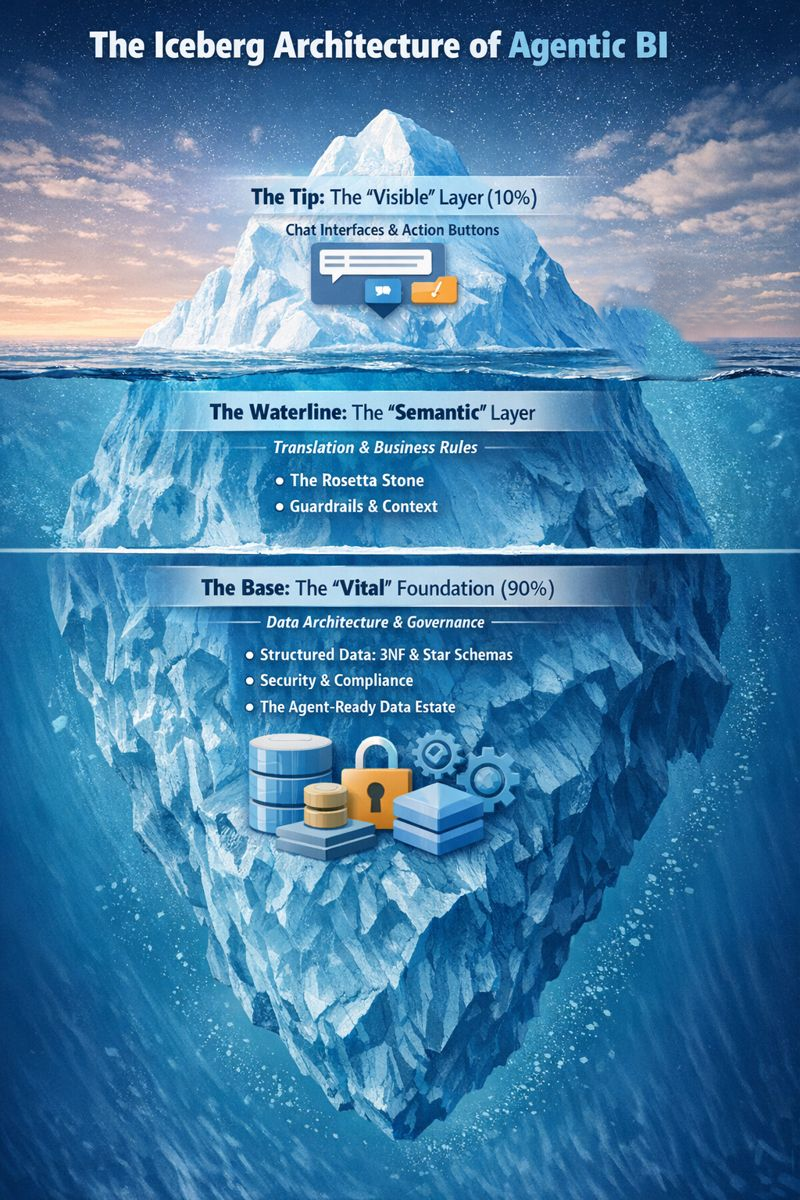
The Iceberg Architecture
Maturity is visible at the surface. Architecture determines what survives below it.
Autonomy is visible. Governance is structural. This is the Submerged 90 Principle drawn as architecture. Ten percent shows. Ninety percent decides
Most organizations focus on the visible layer of AI interfaces, copilots, and action buttons.
But beneath every agent lies a deeper architecture.
The Iceberg Model separates three structural layers:
1. The Visible Layer (10%)
Chat interfaces and action triggers.
2. The Semantic Layer
Business rules, translation logic, context control, lineage.
3. The Structural Foundation (90%)
Data modeling discipline
Security segmentation
Observability and audit controls
Governance enforcement
Autonomy amplifies architectural risk. The exposure is structural, not operational.
An AI agent is only as trustworthy as the semantic layer it queries.
Structure must be translated into operating discipline.
Agent-Ready Data Estate
Containment architecture for enterprise autonomy.
Agentic systems fail because of architectural instability. The Submerged 90 Principle names the gap. The Agent-Ready Data Estate is the maturity model that closes it.
Executive Brief: The Agent-Ready Data Estate →
The Agent-Ready Data Estate defines the structural conditions required for safe autonomy.
It consists of four non-negotiable disciplines:
1. Schema Discipline
Well-modeled, governed data structures, with clear definitions and no hidden dependencies.
2. Semantic Integrity
Business logic encoded in shared translation layers. Clear definitions, lineage, and context boundaries.
3. Segmentation & Policy Enforcement
Security built into the architecture rather than bolted on as approval workflows.
4. Observability & Auditability
Complete traceability of decisions, queries, and transformations. Agents operate inside monitored containment zones.
Autonomy requires containment. Containment requires architecture. Architecture defines stability. Runtime governance prevents escalation. An Agent-Ready Estate is built below the waterline.
Runtime Governance Model
The Circuit Breaker Protocol
Fail-safe containment architecture for autonomous systems. Once the estate is mature enough to permit autonomy, the Circuit Breaker Protocol is the Submerged 90 discipline that governs it at runtime.
When AI agents exceed policy boundaries, generate anomalous behavior, or encounter semantic instability, they must not escalate risk.
The Circuit Breaker Protocol defines automated containment triggers that:
Suspend execution
Revert to safe state
Log decision lineage
Escalate to human review
Autonomy without interruption controls is systemic risk.
Executive Brief: The Circuit Breaker Protocol →
Is your architecture ready for the decisions you want to automate?
Before any agent acts on your data, I validate the governance and architecture below the waterline that decide whether that autonomy is safe.