
Bridging the Gap Between Data Theory and Operational Reality.
In the rush to adopt Agentic AI, organizations often face a critical disconnect: The Architecture they have is not the Architecture they need.
Dr. Malik Al-Amin exists to close that gap.
As a Scholar (D.I.T.), Dr. Al-Amin’s research focuses on the "Socio-Technical Gap"—the precise point where human governance fails and data integrity collapses. He understands that an AI agent is only as intelligent as the semantic layer it queries.
As a Practitioner, he brings deep operational experience, including tenure as Interim Director for UTMB Health. He has led high-stakes modernization initiatives that do not just "move data to the cloud" but transform it into a governed, strategic asset.
The Philosophy:
Infrastructure Precedes Application: We do not build dashboards until the schema is sound.
Governance as Guardrails: We replace bureaucratic "Gates" with automated safety protocols.
Agent-Readiness: We prepare your data estate for the autonomous future.

Why Most Agentic AI Projects Fail Below the Waterline
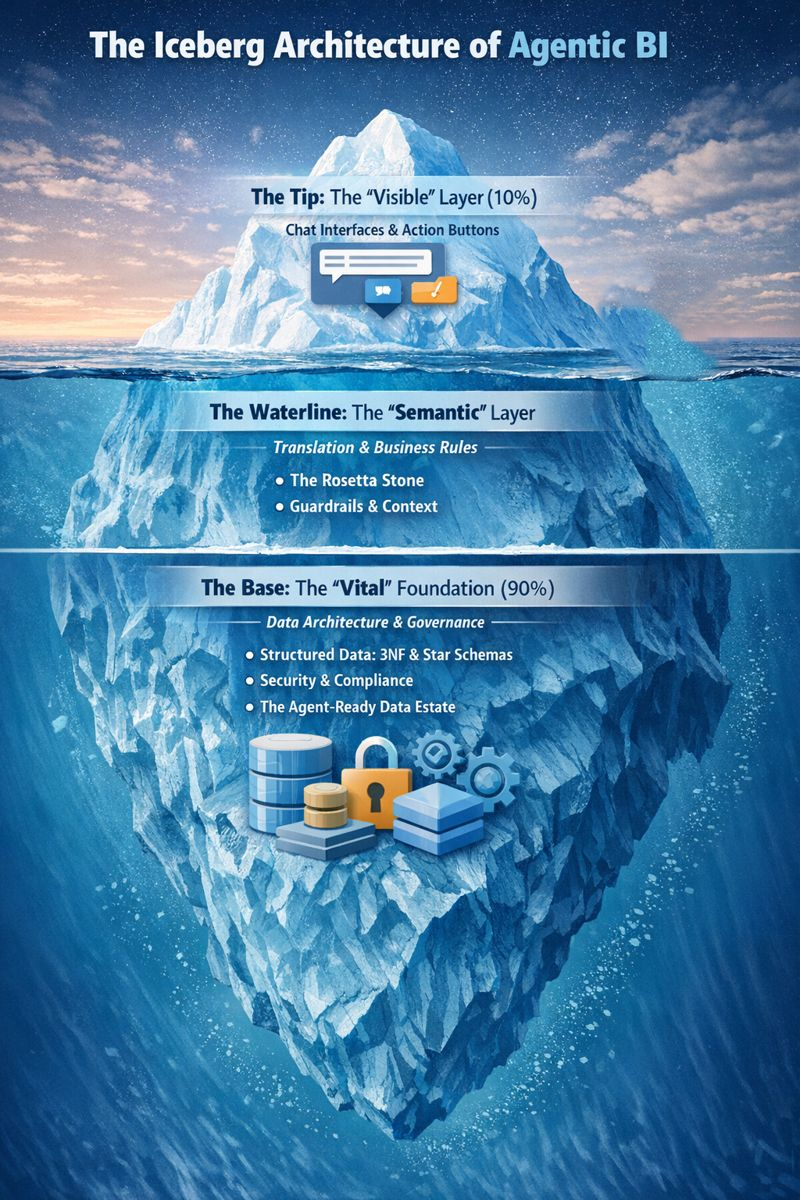
EXECUTIVE SUMMARY In 2026, the enterprise is gripped by an optical illusion. Executives are being sold the "Tip of the Iceberg" — the generative interface, the Copilot, the "magic" chat window. But the success of an AI Agent depends entirely on the Submerged 90%: the unsexy, rigorous architecture of data governance, semantic modeling, and pipeline integrity.
1. The Tip (Above the Waterline):
The Interface of Convenience: The Illusion
To the CEO, this looks like the solution. It is fast, conversational, and demo-ready. It feels like "Modernization."
The Reality: Without a governed foundation, this layer is dangerous. An LLM is a probabilistic engine, not a deterministic one. It is an "Amnesiac Analyst" — intelligent but lacking corporate memory. When an employee asks, "What was our Net Revenue last quarter?", the LLM does not know. It guesses based on data snippets. If those snippets are ambiguous, the Agent hallucinates. You cannot solve a data quality problem with a better prompt; you can only solve it with better architecture.
2. The Scholar View:
The Theory of Information Dissonance
In my doctoral research on Business Intelligence maturity, I explored the "Socio-Technical Gap" — the distance between what a system can do and what the organization knows how to do.
The literature suggests that "Context" is not a technical feature; it is a social agreement. If Finance defines "Churn" one way and Sales defines it another, an AI Agent traversing both datasets will not reconcile the difference — it will amplify the confusion.
The Al-Amin Thesis: We are attempting to build Semantic Autonomy (Agents that act alone) on top of Semantic Chaos (Ungoverned data). This is a structural impossibility.
3. The Practitioner View:
The HIPAA/PII Collision Course
Theory is clean; operations are messy. During my tenure as an Interim Director in a major healthcare system, I witnessed the collision between "AI Hype" and "Regulatory Reality."
The Failure Mode: A standard RAG (Retrieval-Augmented Generation) pipeline retrieves relevant text based on a user's query. But relevance does not equal permission. If a nurse asks about "Ward 4" and the AI retrieves a VIP patient's restricted record, the AI has committed a HIPAA violation. The AI doesn't know the patient is a VIP; it only knows the vector score was high.
The Solution: We halted deployment to build Identity-Aware Retrieval. We forced the Agent to pass the user's OAuth token to the database, ensuring it inherited Row-Level Security (RLS). This is the difference between a demo and an enterprise system.
4. The Technical Anatomy:
The Semantic Rosetta Stone
Deep below the waterline lies the Semantic Layer. This is the critical infrastructure missing from 80% of modern data stacks.
The Problem: Data Warehouses are built for engineers (Table names like
T_SALES_F_2025). AI Agents talk like humans ("Show me Sales").The Solution (Metrics-as-Code): We must build a translation layer where "Gross Margin" is defined in code (Revenue - COGS). The Agent is forbidden from calculating this itself; it must query the Semantic Layer.
CONCLUSION: THE ADULT IN THE ROOM The "Iceberg Architecture" is not about slowing down innovation. It is about sustainable velocity. You can build a "Tip of the Iceberg" demo in a weekend. But to build a system that protects patient data and secures financial assets, you must respect the depth