
Most BI Implementations Fail
Despite massive investment, BI projects fail to deliver their expected return as often as 80 percent of the time. In my doctoral research I analyzed why, studying the critical success factors that separate the implementations that succeed from the ones that fail. The finding was consistent. This is rarely a technology failure. It is a failure of organizational readiness, and without a governance framework to address it, a cloud migration simply moves technical debt from on-premise to the cloud, raising cost without delivering insight.
THE CLOUD BI ADOPTION FRAMEWORK
Successful Cloud BI is an organizational transformation before it is a software purchase. Based on qualitative inquiry with veteran BI practitioners, I identified six factors that separate the implementations that turn data into advantage from the ones that fail:
Strategic Alignment and Executive Leadership: Moving beyond passive support to executive ownership of the KPIs and the mission.
Project Governance, Planning and Resource Management: Formal demand management and intake structures that prevent scope creep and allocate scarce resources.
Technical Architecture, Engineering and Cloud Platform Execution: Modular, scalable pipelines built on sound architecture rather than ad-hoc cloud builds.
Collaboration, Communication and Stakeholder Partnership: Business stakeholders embedded as co-creators of the solution, not just consumers of it.
Data Quality, Governance and Trust: Stewardship and lineage that make accuracy something the business can rely on.
End-User Engagement, Adoption and Change Management: Engaging end users in the design phase, not just at handover.
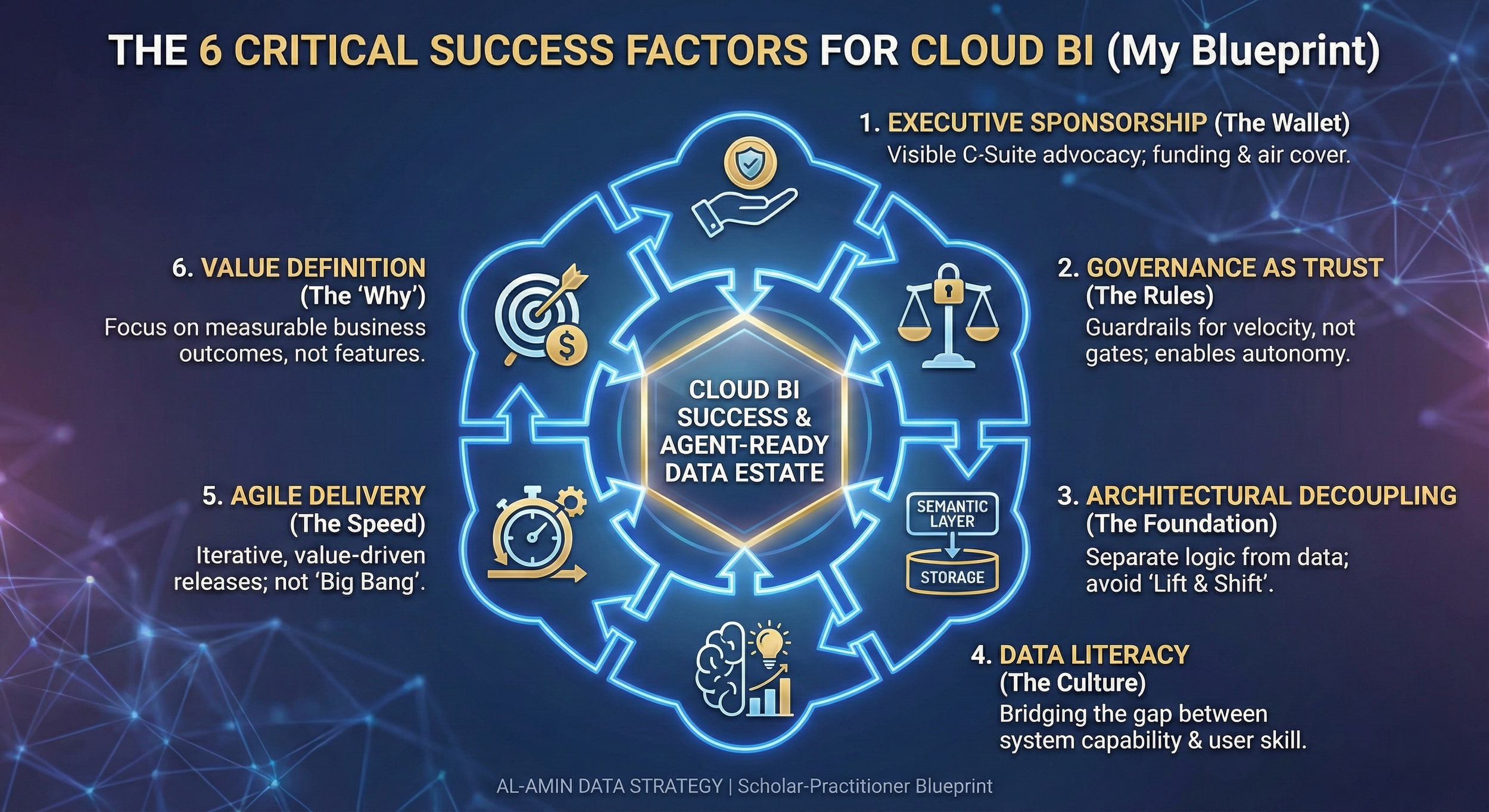
The 6 Critical Success Factors for Cloud BI (My Blueprint).
EXECUTIVE STRATEGY | 3 MIN READ